Clare Maas
2017-07-27
This article explores discrepancies between the topics included in ELT textbooks and the actual topics of conversation in English learners' encounters with peers. Based on the research findings, it suggests topics for inclusion in textbooks or supplementary materials that would perhaps better prepare English learners for interactions with international peers.
Siegel, A., (2014) 'What should we talk about? The authenticity of textbook topics', ELT Journal, 68/4, pp. 363-75. Available here.
Introduction
Much research has been concerned with the authenticity of language presented in ELT textbooks, but not so much with the topics. Nonetheless, the choice of topic has shown to be important for empowering learners, facilitating learning (Cummins 1994) and promoting willingness to learn (Kang 2005). Still, different research has emphasised different types of topics as important; those focussing on local culture (McKay 2003), or those selected by the learners themselves (Wolf 2013), for example. Siegel notes the lack of research concerned with the 'authenticity' of textbook topics measured by their relevance to learners' interactions outside the language classroom. This study therefore aimed to counteract this research gap by investigating topics that arise in non-classroom conversations in English between Japanese and non-Japanese students at an international university.
Research & Results
The study involved three phases of research:
- surveying topics presented in textbooks available on the Japanese EFL market,
- collecting and analysing conversations between Japanese and non-Japanese speakers of English,
- categorising and comparing the topics collected in phases 1 & 2.
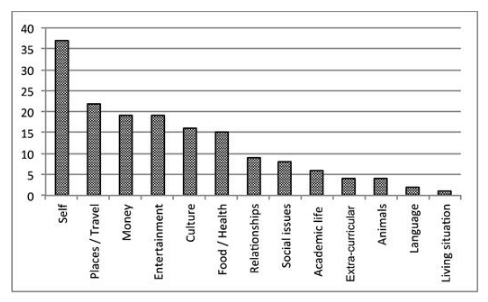
Regarding phase 1, the graph above shows the frequency of thematic topics found in the 11 surveyed textbooks, categorised by Siegel. Most frequently found was the topic of 'Self', which included specifics such as Likes, Dislikes, Family, Past and future plans . The second most frequently found topic category was 'Places/Travel', which included specifics such as Hometown, City life, Vacation, Travelling. The topics 'Money' (Jobs, Business, Money, Shopping) and 'Entertainment' (Music, Movies, TV, Sports, Video games) were found similarly frequently in third and fourth place.
For phase 2, students were asked to video conversations in their dorms. The participant students were international students with B2 English and limited Japanese skills, and four domestic Japanese with B1-2 English. The Japanese students recorded their spontaneous and unscripted conversations with various international students, creating a total of 37 hours of video material, which was analysed using Conversation Analysis conventions (Jefferson 2004). The topics found through the analysis were categorised into the same 13 thematic categories as the topics from the textbooks. The graph below shows the frequencies of each thematic topic.
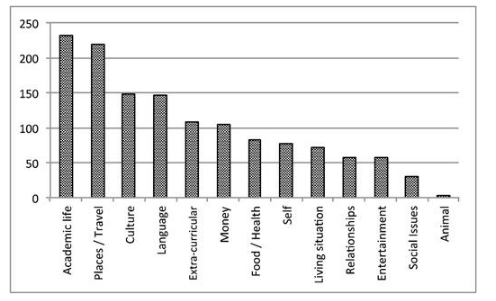
In contrast to the topics found most frequently in the surveyed textbooks, the analyses of these conversations show 'Academic Life' as the most frequently discussed topic, including such specifics as University courses, Teachers, Homework, Tests, and Study abroad. The categories of 'Culture' (Holidays, Ceremony, Climate, Religion, Behaviours of people of a certain ethnicity) and 'Language' (Japanese, Chinese, Language classes) were also very common. Although 'Places/Travel' was still in second place, 'Self' was far less frequently a topic of actual conversation than in textbooks.
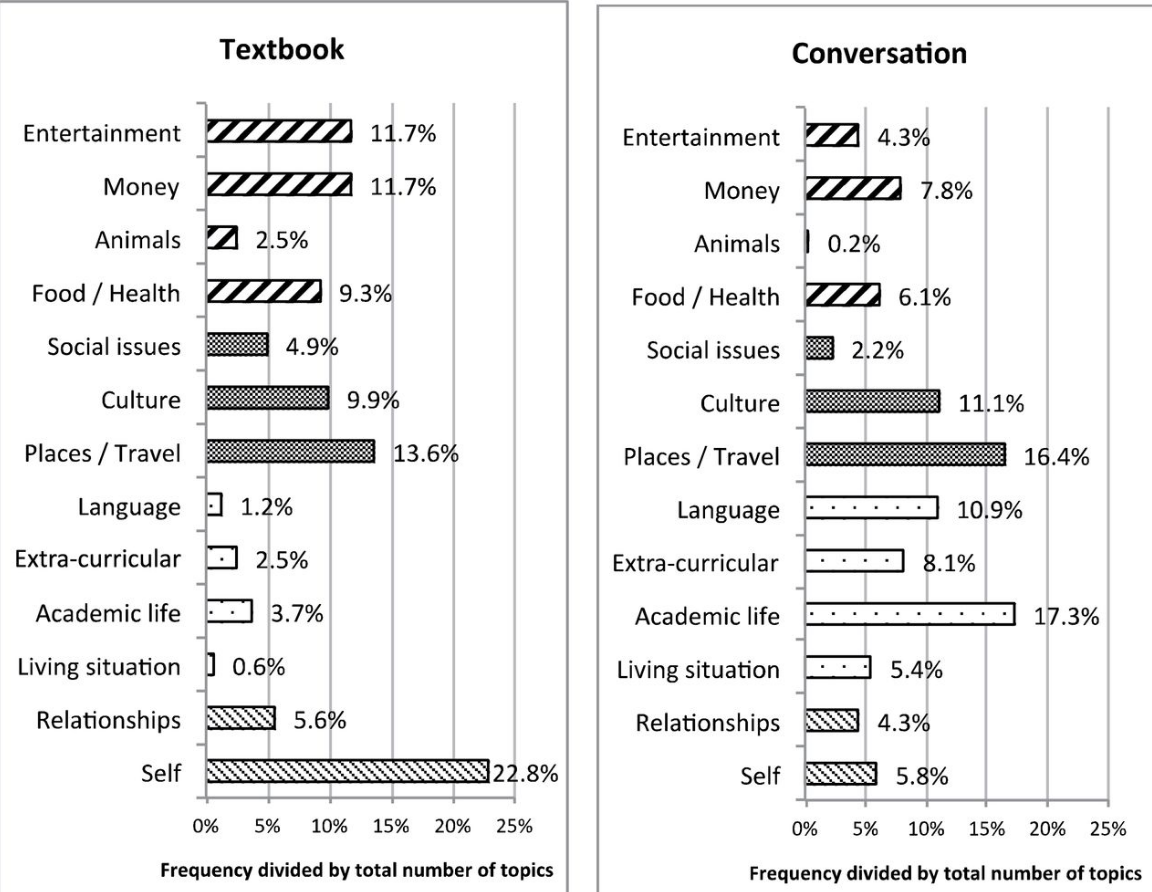
To enable easier comparison of the topics found in textbooks and in actual conversations, phase 3 of the research involved grouping some of the categories together. ‘Self’ and ‘relationship’ were grouped together. General topics such as ‘food and health’, ‘animals’, ‘money’, and ‘entertainment’ were grouped as ‘everyday topics’. All topics related to university life, such as ‘living situation’, ‘academic life’, ‘extra-curricular activities’, and ‘language’ were grouped as ‘school life’. The category ‘social topics’ included topics related to life outside of university, and more global topics such as ‘places and travel’, ‘culture’, and ‘social issues’.
Some clear contrasts became apparent through this comparative analysis: Everyday topics comprised 35% of all textbook topics, but 18% of conversation topics. The Self comprised 28% of all textbook topics, but 10% of conversation topics. School life comprised 8% of all textbook topics, but 42% of conversation topics. The graphs below visualise these comparisons in more detail, using the original 13 categories.
Discussion & Suggestions
Topics related to the immediate social situation of the learners, e.g. classes attended, extra-curricular activities, living situations, and students' L1s, were largely absent from textbooks although these were popular conversation topics among the learners in their free time; teachers and future materials writers may therefore be advised to include more of these topics to give learners the vocabulary and pragmatic conventions needed to discuss their lives as students. This may also include academic terminology for subjects and specialisms, which would also be useful for students beyond their time at university.
The findings also support claims that local cultural elements (e.g. holidays, traditions, social values) could be useful for learners to encounter in their langauge textbooks or classrooms. Including these kinds of topics would prepare learners for interactions with people from other cultures and may also heighten their motivation.
Siegel notes that, although social issues topics did not feature very frequently in either textbooks or conversations, classes that aim to promote critical thinking and social awareness may require supplementary materials on controversial and thought-provoking topics to ensure exposure and provide learners with the langauge to tackle potentially sensitive topics.
From these analyses, Siegel concludes that it important "to find out the students’ experiences, interests, and needs when selecting conversation or discussion topics for class, not only to facilitate interest, but also to prepare the students better for real-life interactions."
References
Cummins, J. 1994. ‘Knowledge, power, and identity in teaching English as a second language’ in Genesee, F. (ed.). Educating Second Language Children. Cambridge: Cambridge University Press.
Jefferson, G. 2004. ‘Glossary of transcript symbols with an introduction’ in Lerner G. H. (ed.). Conversation Analysis: Studies from the First Generation. Amsterdam: John Benjamins.
Kang, S. 2005. ‘Dynamic emergence of situational willingness to communicate in a second language’. System, 33/2: 277–92.
McKay, S. 2003. ‘Teaching English as an international language: the Chilean context’. ELT Journal, 57/2: 139–48.
Siegel, A., (2014) 'What should we talk about? The authenticity of textbook topics', ELT Journal, 68/4, pp. 363-75.
Wolf, J. P. 2013. ‘Exploring and contrasting EFL learners’ perceptions of textbook-assigned and self-selected discussion topics’. Language Teaching Research, 17/1: 49–66.