Mura Nava
2018-04-04
The structural syllabus (consisting of a list of grammar items taught in a certain sequence) has been with language teaching ever since people had to decide what to teach when learning a language. Scott Thornbury has characterised the results of a survey which showed the popularity of such syllabuses as "dispiriting". However, Rod Ellis, in a 2018 paper, writes of a more positive outlook which includes a "structural syllabus" as a checklist in a modular curriculum which emphasizes task-based components.
Two kinds of syllabus; task-supported & task-based; (in)compatibilities
In the first section, Ellis runs down a quick history of syllabus types ranging from structural vs. notional/functional; synthetic vs. analytic; Type A vs. Type B; product vs. process; and accuracy vs. fluency. Although each of these dichotomies have their various definitions they can be summed up as: the blue pill (falsehood, security, happiness & blissful ignorance of illusion) vs. the red pill (knowledge, freedom, adversity & brutal truth of reality). 😀
In section two he goes onto to describe Task-Supported Language Teaching (TSLT) and Task-Based Language Teaching (TBLT) which have been seen as mutually incompatible - TSLT is said to draw on synthetic, Type A, product, and accuracy approaches whilst TBLT is said to draw on analytic, Type B, process, and fluency approaches. Further incompatibilities between TSLT and TBLT arise from differing theoretical bases, TSLT - skill acquisition, TBLT - social interaction/usage based/implicit or incidental acquisition.
However, Ellis argues for the compatibility of TSLT with TBLT following Christopher Brumfit, who wrote about integrating product and process syllabuses. A product or structural syllabus recognises 1) systematicity or someway to organize a syllabus, 2) expectations about learning that students bring and 3) real world educational contexts in which syllabuses have to work in. Ellis reports further points raised by William Littlewood of the challenges of using a process syllabus such as in TBLT in Chinese contexts e.g. large classes, demands of TBLT on skills of teachers, L1 use in tasks.
Brumfit argued that a process syllabus can be used with a product based syllabus when it places controls on what should happen in class. In Brumfit's integrated model, the figure below shows accuracy dominates initially before giving way to fluency:
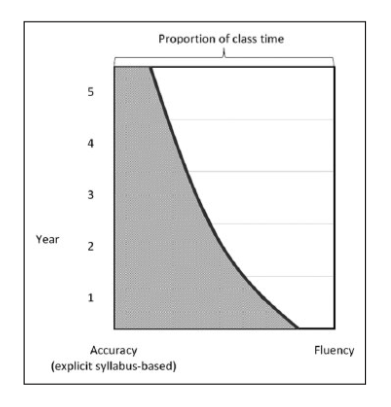
Brumfit’s integrated curriculum model.
Ellis's model uses the notions of implicit and explicit knowledge. Implicit language knowledge is primary (i.e. the goal of language instruction) while explicit language knowledge is secondary but can help with developing implicit knowledge. There are three logical possibilities of relating structural components to task based components - parallel positioning, structural before task, task before structural.
Rather than an integrated curriculum, Ellis prefers a modular syllabus (i.e. structural & task-based components are kept separate). Ellis also argues for the third option - task based components should come before structural components as shown in the next figure:
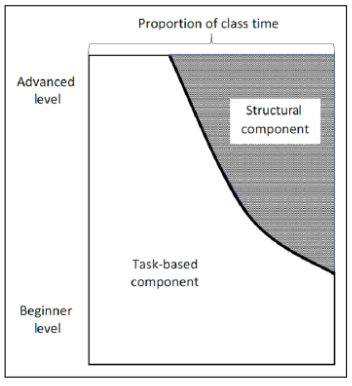
Ellis's modular curriculum model
Although Ellis's framework has separate components, there are opportunities for integration for any particular classroom activity. Ellis promotes the benefits of consciousness-raising tasks to avoid problems of teaching explicit forms for which learners are not developmentally ready and the problem of missing grammar features when using reactive focus on form in tasks.
Determining content for task and structure
It is possible to use needs analysis and identify specific tasks (such as buying a railway ticket, buying an airline ticket) and group these into types (buying a ticket). Problems with this include feasibility with young learners and how general task types should be. Can we expect learning to transfer from one task to another? More problematically - can language proficiency be seen as domain and task specific rather than as set of general competences available across task types? Concept-based syllabuses from socio-cultural theory attempt to address the issue of transfer.
Ellis goes onto to describe selecting tasks more on interactional authenticity than situational authenticity. That is, focusing on task takers characteristics in accomplishing a task. For large scale teaching, N.S. Prabhu recommends syllabus designers basing tasks on general characteristics such as topics (e.g. maps; school timetables) and the particular operations a task demands (finding, naming, describing specific locations on a map; making class timetables from instructions):
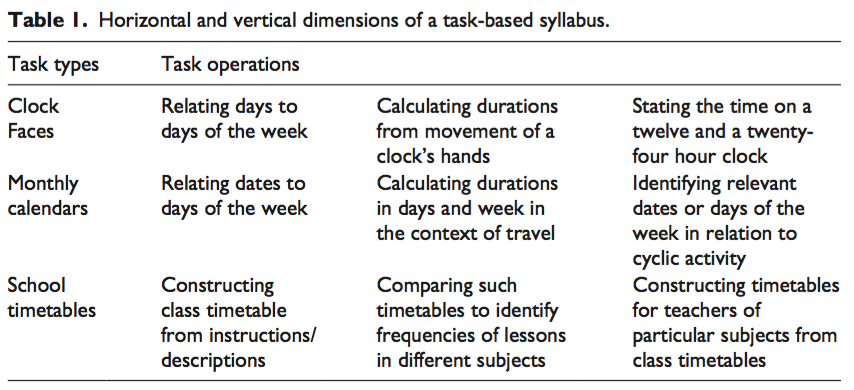
Prabhu's vertical and horizontal sequencing
The table shows both vertical sequence of task types and horizontal sequence of task operations (sequencing is concerned with complexity and timing issues). Various ways to sequence task types include potential familiarity of topics of the task, how close or remote to lives of students topics are, from facts to reasoning to opinions, from input-based tasks with closed outcomes to output-based tasks with open outcomes. For horizontal sequencing, we can look at amount of information to be handled, nature of reasoning needed, precision needed in interpreting information and reaching outcomes, degree of abstractness. However, defining task complexity remains unsolved and we fall back on relying on common-sense notions such as topic familiarity and learners’ interest.
For structural content, many course books use one that has not changed much over the years. In Ellis’s modular syllabus, structural components are used as a checklist not a syllabus - there is no expectation teachers follow the order of a list or need to teach all items. So in this case there is no problem of how to grade and sequence items. However we still need to decide what items to include.
Here we can look at items known to cause difficulties for learners to acquire incidentally - e.g. from research on fossilisation where L1 known structures interact with L2 input structures. Ellis gives the following as examples - past tense, third person -s, epistemic modal verbs, articles, passive clauses, unreal conditionals, unusual/exceptional word orders. But such work from research can only ever be a generalized account and so teachers need to see what problems their learners actually have. That is, from how learners perform on the task-based section of the syllabus teachers can identify relevant grammar content for the structural aspect.
Conclusion
Critics of Ellis may argue that a structural syllabus is fundamentally incompatible with any non-structural syllabuses such as task-based ones. Without wanting to gloss over such critiques, the framing of a grammar list as simply a list and nothing more is, for me, a very useful, guilt-reducing idea. If you accept Ellis's line of thought there is reason to be cautiously cheerful regarding the apparent widespread use of structural syllabuses, contrary to the dispiriting assessment of Thornbury's survey. I also think Ellis's approach is in tune with the multi-faceted nature of language learning - we can have our structural syllabus and eat it as well.
References
Ellis, R. (2018). Towards a modular language curriculum for using tasks. Language Teaching Research, DOI 10.1177/1362168818765315.